







Play Mat Sizing: How Big a Mat Do You Actually Need?
Play mats are one of the few things in a nursery you cannot really eyeball. They are heavy, they are awkward to return, and the difference between the right size and the wrong one is usually a measurement nobody took. Here is how to get it right the first time.
Measure the floor you can actually clear, not the room. A 3 by 4 metre room with a sofa, a bookcase and a radiator has perhaps 2 by 2.5 metres of usable floor, and the mat has to live in that number.
Start with the floor you actually have
Clear the space first, then measure. Not the room dimensions from the listing, and not the space as it will be once you have moved the armchair you have been meaning to move for a year. Measure what is genuinely free today.
Then take 10 to 15 centimetres off each side. A mat pushed hard against a baseboard curls at the edge, traps dust behind it, and stops sitting flat. A small gap keeps it flat and makes it far easier to lift and clean under.
Finally, open every door that swings into the space and check the arc. A 4 centimetre thick mat will catch under a door that clears the floor by 3. This is the single most common reason a mat gets sent back.
Thickness is a separate decision from size
People choose length and width carefully and then take whatever thickness comes with it. Thickness is doing a different job, and it is worth choosing deliberately.
One thing worth saying plainly: a thicker mat softens a fall, but no play mat makes a fall safe. Thickness is comfort and noise reduction with some cushioning attached, and it does not replace supervision.
Size by what it is actually for
Tummy time and the newborn months
You need far less than you think. Something in the region of a metre square is ample, and its real job is being easy to wipe and easy to move from room to room. Many families buy small here and buy again later, which is a reasonable way to do it.
Crawling and cruising
This is where mats get outgrown fastest. A crawling child covers ground surprisingly quickly, and a mat that ends abruptly at a hardwood edge stops being useful. Around 200 by 140 centimetres is a sensible working minimum for a main living space.
A long run for walking and ride on toys
Once they are walking, length matters more than width. A long narrow mat down the centre of a room gives a runway, protects the busiest strip of floor, and leaves the edges free for furniture. Something like 300 by 110 centimetres suits a hallway or a narrow living room better than a square of similar area would.
Inside a playpen
The mat and the pen have to be bought as a pair, and this is where people come unstuck. A pen has an internal footprint, and a mat that is 5 centimetres too wide will not lie flat inside it. Our Ggumbi pens are sized to the Ggumbi mats deliberately, so if you are combining the two, match them rather than measuring hopefully.
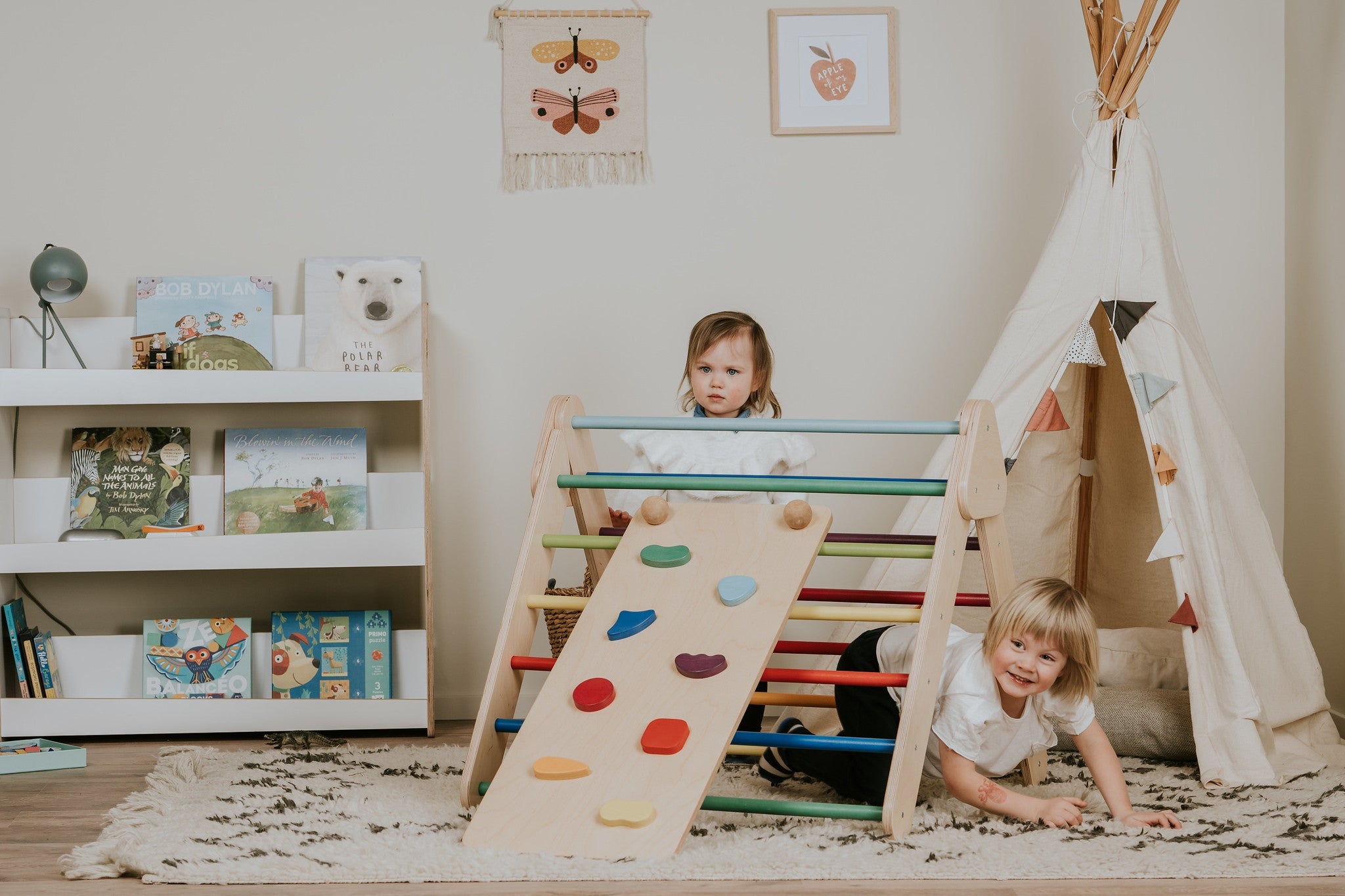
Under a climber or a Pikler triangle
If the mat is going under climbing equipment, size it to the equipment rather than to the room.
The mat should extend well past the footprint of the frame on every side, because a child does not fall straight down, they fall outward. Work from the widest point of the frame when it is fully open, including any ramp or slide attachment, and give yourself margin beyond that.
Your climber's own instructions are the authority here. Every frame we sell ships with the manufacturer's guidance on clearance and use, and where that differs from anything on this page, follow the manufacturer.
Size chart
Real dimensions from the mats and pens we carry, in both units.
| Product | Centimetres | Approx. feet and inches | Thickness |
|---|---|---|---|
| Lucky Star Quilted Cotton Pad XL | 100 × 140 | 3'3" × 4'7" | Quilted pad |
| Licoco Clean Roll Foldable | 200 × 140 | 6'7" × 4'7" | 4 cm |
| Licoco Self it Roll | 300 × 110 | 9'10" × 3'7" | 1.8 cm |
| Licoco XL | 500 × 140 | 16'5" × 4'7" | 2.2 cm |
| Lucky Star playpen footprint | 140 × 189 | 4'7" × 6'2" | Pen only |
Imperial figures are converted and rounded, so use the centimetre column when you are measuring a tight space.
 Licoco Clean Roll Foldable
200 × 140 cm, 4 cm thick
Licoco Clean Roll Foldable
200 × 140 cm, 4 cm thick
 Licoco Self it Roll
300 × 110 cm, 1.8 cm thick
Licoco Self it Roll
300 × 110 cm, 1.8 cm thick
 Lucky Star Quilted Cotton Pad XL
100 × 140 cm
Lucky Star Quilted Cotton Pad XL
100 × 140 cm
 Lucky Star Play Pen Set
140 × 189 cm footprint
Lucky Star Play Pen Set
140 × 189 cm footprint
Three mistakes that cause returns
Before you order
- Clear the space and measure the free floor, then subtract 10 to 15 centimetres per side.
- Measure the gap under every door that swings into the room.
- Decide whether you need length or area. They are different problems.
- If it is going under a climber, measure the frame at its widest open position first.
- If it is going in a pen, work from the pen's internal footprint.
- Check the delivery terms for large items on our shipping policy page before you order, since the biggest mats travel differently to the rest of the catalogue.
Questions we are asked
Should I size up so it lasts longer?
Usually yes, if the floor allows it and the door clears it. Mats are outgrown by area covered rather than by wear, and the cost of buying twice is higher than the cost of buying larger once.
Can I put two mats side by side?
You can, and plenty of families do. Be aware that the seam is where crumbs and liquid gather, and that two mats will slide apart under an active child unless they are held by furniture on both sides.
Is a thicker mat safer?
It is more forgiving, which is not the same thing. A thicker mat reduces the impact of a stumble and cuts noise on a hard floor. It does not make falls safe and it does not replace supervision.
Will a folding mat stay flat?
Give it a day or two out of the packaging. Fold lines settle with time and with the weight of the mat itself. If a corner is stubborn, weight it overnight.
What size goes under a Pikler triangle?
Larger than the frame, on all sides, measured with the frame fully open including any ramp. Your climber's manufacturer instructions are the authority on clearance.
Still not sure
Send us the measurements of your usable floor, the gap under your door, and a note on what the mat is for. We will tell you which size fits, and we will tell you if the honest answer is that none of them do.
Browse the full range of play mats and play pens, or see our Pikler triangles and climbing frames if you are sizing a mat to go underneath one.


Leave a comment